Saudi Arabia’s ammonia ambitions have moved from strategy to steel.
On September 10, SABIC Agri-Nutrients took a final investment decision on its seventh production complex in Jubail Industrial City and awarded a $3.465 billion engineering, procurement and construction contract to South Korea’s Samsung E&A. The project, known as San VII, pairs a 1.2 million tonne per year ammonia plant with two urea plants totalling 2.6 million tonnes a year, plus a post-combustion carbon capture unit.
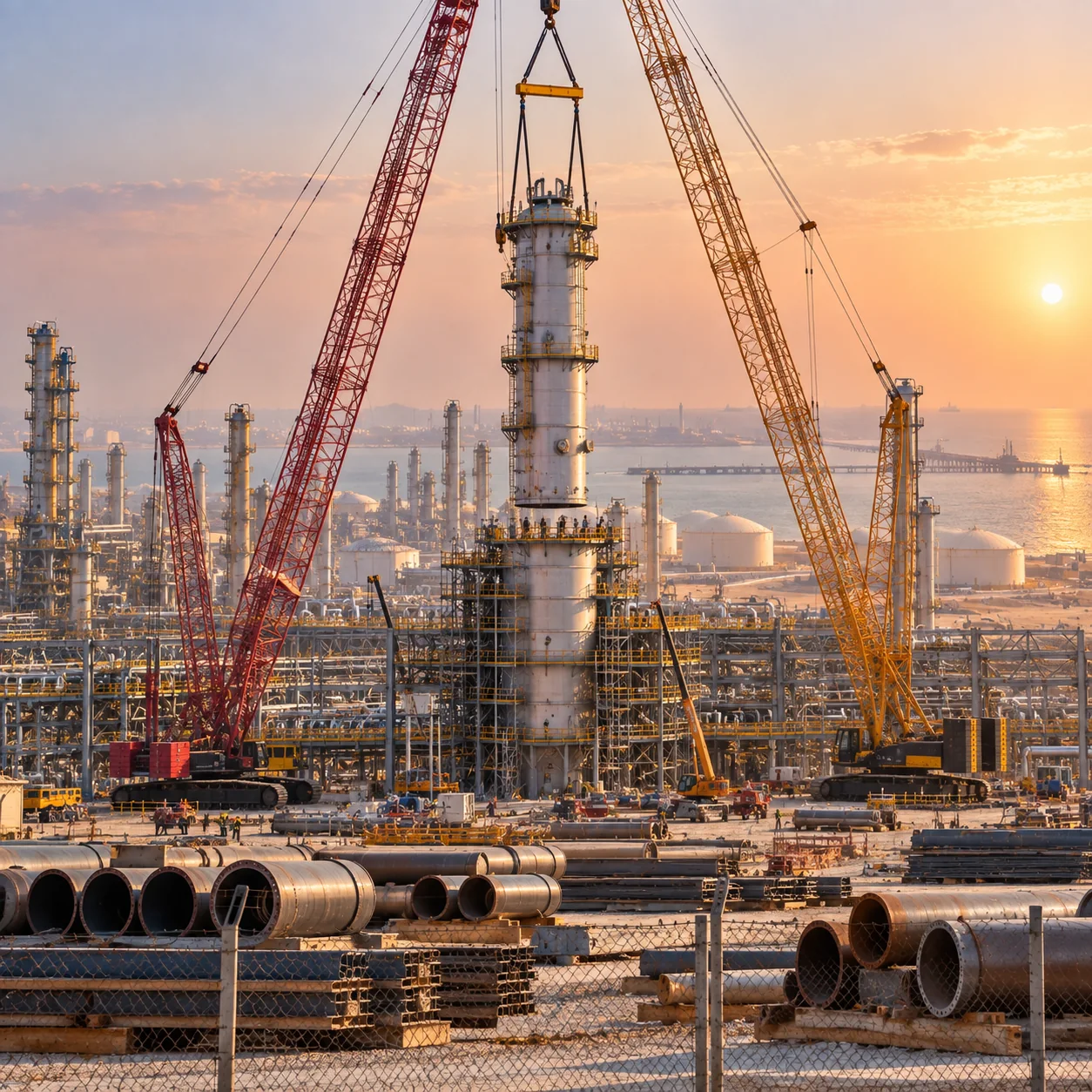
The scale is significant. According to the company, the expansion lifts its urea capacity by about 54 percent, from 4.8 million to roughly 7.4 million tonnes a year. MEED reports that construction is due to start in the fourth quarter of 2026, with commissioning in the third quarter of 2030 and commercial production following in the fourth quarter.
For a region focused on energy security, that matters well beyond fertiliser.
Turning Gas Into a Tradeable Export Product
Ammonia is one of the most practical ways to convert hydrocarbon resources into a product that moves on existing shipping, storage and port infrastructure. Urea carries that value further down the chain into one of the most widely traded agricultural commodities in the world.
San VII does both. It processes Saudi feedstock in one of the kingdom’s established industrial hubs and sends the output into global markets as a finished product rather than raw energy.
That is diversification in a very concrete form.
According to Arab News, SABIC Agri-Nutrients is targeting Asia, the United States and Canada to absorb the additional volumes. That is a broad customer base, and it spreads commercial exposure across several regions instead of tying growth to a single buyer market.
Carbon Capture Is Built In From Day One
The post-combustion carbon capture unit, which will use Shell Global Solutions technology, is one of the more telling design choices. Chief executive Fahad Al-Battar said the project “contributes to achieving its sustainability and carbon neutrality targets”, Arab News reported.
MEED reports that San VII replaces an earlier blue ammonia initiative. The company has instead chosen conventional ammonia production with carbon capture integrated into the complex. That structure gives it an established product with established buyers, while still lowering the emissions intensity of what it ships.
It is a pragmatic route.
Low-carbon ammonia markets are still forming, with offtake terms and certification rules continuing to develop. A plant that can sell into the existing urea market while carrying a lower-carbon profile gives the operator room to move as those markets mature, without betting the whole investment on how quickly they do.
A Proven Technology Stack Lowers Execution Risk
The licensor line-up will be familiar to anyone who follows large fertiliser projects. The ammonia plant will use Kellogg Brown & Root technology, the urea units will run on Stamicarbon and thyssenkrupp Uhde Fertilizer Technology processes, and the carbon capture unit will use Shell’s technology.
For investors and lenders, that combination matters. Large Gulf industrial projects rarely fall short on ambition. They are tested on execution, schedule and cost. Proven process technology, an experienced Korean EPC contractor and a site inside Jubail’s existing utilities and logistics network all reduce the number of unknowns.
That makes the 2030 timeline credible.
On funding, Arab News reports the company is evaluating options including loans and internal cash flows, with the financial impact expected to show once commercial operations begin.
What the Industry Should Watch Through 2030
On paper, San VII is a fertiliser project. In practice it fits a broader Gulf shift toward capturing more value from domestic resources and building export products that sit closer to end users. Several threads are worth tracking as it moves into construction:
- How the carbon capture unit performs and where captured CO2 is used or stored
- Whether premiums for lower-carbon nitrogen products emerge in Asian and North American markets
- Demand for long-lead equipment such as compressors, reactors and heat exchangers
- Contracting and service opportunities for local firms in Jubail
- Port, storage and shipping capacity to handle higher export volumes
- Whether other regional producers follow with downstream ammonia investments of their own
Food Security and Energy Security Are Converging
SABIC Agri-Nutrients framed the expansion as support for Saudi Arabia’s role in the global food security system. That framing deserves attention. Nitrogen fertiliser depends on reliable gas supply, reliable processing and reliable shipping. Producers that can deliver all three become strategic suppliers to importing nations.
For buyers in Asia and North America, a larger Saudi supply base adds options. For Saudi Arabia, it deepens trade relationships built on a manufactured product rather than crude alone, and it supports the export diversification goals set out under Vision 2030.
Who controls the molecules?
Who can turn them into products the world needs every growing season?
Increasingly, the answer to both questions sits in the same industrial cities.
San VII will take four years to build. The strategy behind it is already clear: the Gulf’s energy advantage is increasingly measured by what it manufactures, not only by what it extracts.