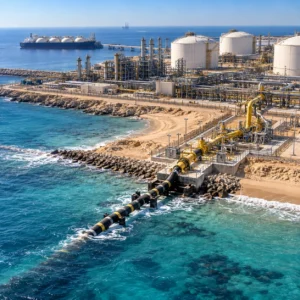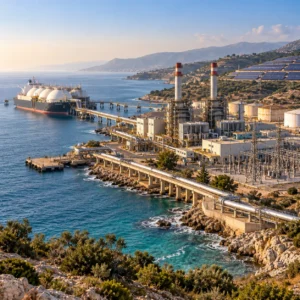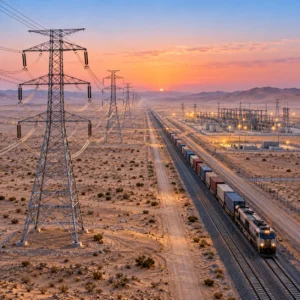
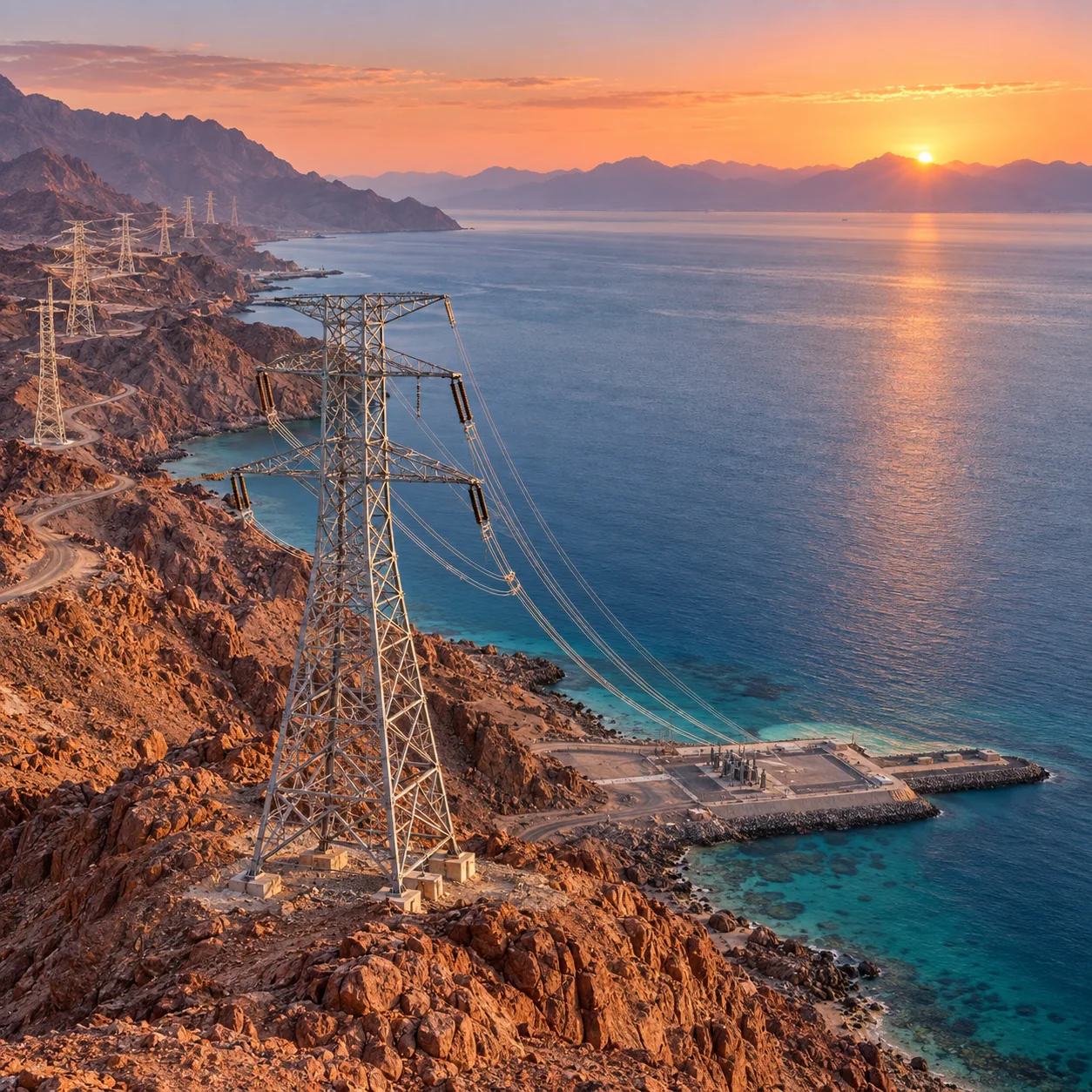
The Arab world’s most ambitious power link is close to switching on.
Saudi Arabia and Egypt are in the final stages of technical and operational trials on their 3 GW electricity interconnection, according to EnterpriseAM reporting on August 26. Pre-operation testing was expected to conclude by the end of August, with full commercial operation anticipated in September 2026.
The $1.8 billion project uses 500 kV high-voltage direct current technology to join Egypt’s Badr converter station to Saudi Arabia’s East Madinah and Tabuk stations. The route runs across roughly 1,400 km of overhead lines and subsea cables crossing the Gulf of Aqaba.
In a year when energy security across the Gulf and the Eastern Mediterranean has been tested hard, a working connection between two of the region’s largest power systems is a meaningful step. It adds resilience that does not depend on a single shipping lane, a single fuel or a single national grid.
The Final Checks Are About Confidence, Not Construction
The heavy construction is largely done. Phase 2 of the project was completed in the first quarter of 2026, according to EnterpriseAM, and the remaining work centres on proving that the two grids can operate safely as one connected system.
Coordination meetings between the two sides have focused on verifying compliance with technical standards and confirming that the Phase 2 works “have left both grids ready for operation.” Results from precision measurements of voltage, frequency and other parameters will set the timing of commercial start.
That sequencing matters.
An HVDC link of this size ties together two systems with different generation mixes, operating practices and control centres. Getting protection settings, power flow controls and dispatch arrangements right before commercial service is what turns a new transmission asset into a dependable one.
Different Peaks Create Shared Capacity
The commercial logic of the link rests on a simple observation. Saudi Arabia and Egypt do not reach peak demand at the same times, and the interconnection is designed to let power trade follow those differing schedules, according to EnterpriseAM.
In practice, each country can draw on the other’s spare capacity rather than building and maintaining every megawatt of peak reserve alone.
For system planners, that is effectively new capacity without a new power plant.
The link also creates an outlet for renewable output. According to Power Technology, Saudi Arabia targets a 50 percent share for natural gas and renewables in its power mix by 2030, while Egypt targets 42 percent renewable generation by 2035. As both countries add large volumes of solar and wind, a 3 GW corridor gives surplus generation somewhere to go, and gives each grid a reserve to draw on when output dips.
On the Egyptian side, the Badr station is designed to dispatch 1.5 GW, or half of the project’s total exchange capacity, into the national grid, Power Technology reports.
Protecting the Cable Becomes Part of the Business Case
The supply chain behind the project shows how specialised regional grid integration has become. Hitachi Energy is delivering the three HVDC converter stations, while Prysmian secured a €221 million contract in September 2021 for the design, supply, installation and commissioning of the submarine and land cable system, according to Power Technology. The original agreement was signed by the Egyptian Electricity Transmission Company and Saudi Electricity Company.
Both governments are now looking beyond commissioning. Saudi Arabia is launching a tender for an international consultant to oversee cable maintenance, and Egypt is preparing a tender to select an international firm to ensure subsea cable security, EnterpriseAM reports.
That is a sign of maturity. A subsea crossing carrying up to 3 GW between two countries is critical infrastructure, and treating its protection as a dedicated workstream from day one is exactly how operators should approach cross-border assets.
Egypt’s Hub Ambitions Gain Their Anchor Asset
Egypt describes the Saudi link as its largest interconnection project. It sits alongside existing connections with Sudan, Libya and Jordan, and planned links to Greece and Cyprus through the GREGY project, according to EnterpriseAM.
Taken together, those links point toward a role for Egypt as a power trading crossroads between the Gulf, North Africa and Europe.
Can a grid that once struggled to meet its own summer peaks become a transit system for others?
Can Gulf solar eventually reach Mediterranean markets over wires rather than molecules?
The Saudi interconnection does not answer those questions on its own. It does provide the first large-scale proof point that cross-border HVDC trading can work in the region.
What Utilities and Investors Should Watch Next
Once commercial operation begins, attention will shift from engineering to market design and performance. Several signals will show how quickly the link delivers value:
- Final trial results on voltage, frequency and stability performance
- Commercial rules governing how and when power is exchanged
- Award of the cable maintenance and subsea security contracts
- Utilisation rates during each country’s peak demand periods
- How the link absorbs growing solar and wind output
- Progress on follow-on links such as GREGY
For developers, the strongest opportunity may lie in what the interconnector enables around it. Renewable projects near the converter stations, grid-scale storage that can work alongside cross-border flows, and services that keep long HVDC assets secure and available all become more valuable once two large systems are joined.
For investors, a working Saudi-Egypt link offers a template that other regional interconnection projects can point to when seeking financing.
The region built its first energy era on pipelines and tankers. The next one will also run on cables.